
Caves in Slovakia: Ice, Stalactites and Aragonite
Beneath Slovakia’s mountain ranges lie caves with strikingly different landscapes: stalactites and stalagmites, underground streams, year-round ice, and rare aragonite formations. Some are open to visitors as show caves; they differ considerably in location, route, and physical demands. Choosing a cave that fits your day’s itinerary can make it easier to combine your visit with time in the mountains.
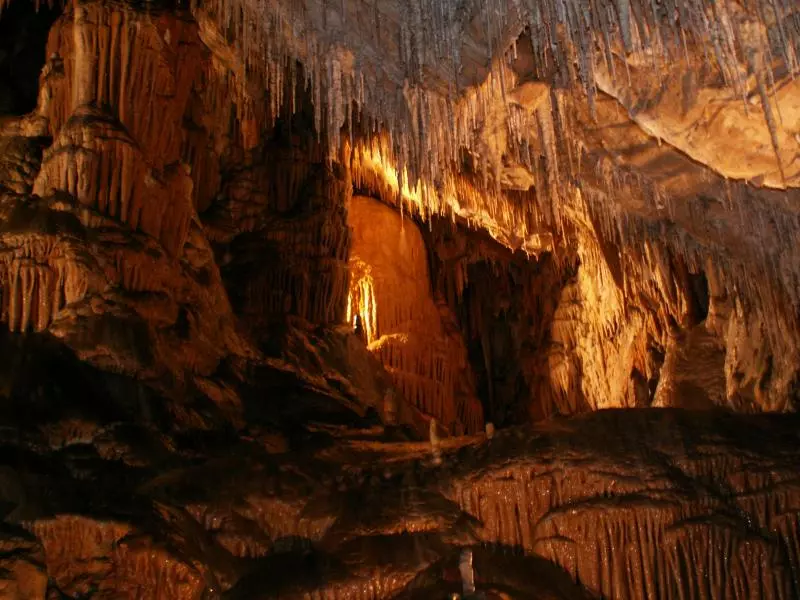 Höhlen der Slowakei
Photo: RRinnau
Quick facts
- Dobšiná Ice Cave: A World Heritage Site in the Slovak Paradise area; the visitor route is 515 metres long.
- Demänovská Cave of Liberty: Stalactites and stalagmites, an underground river, and several route options in the Low Tatras.
- Ochtinská Aragonite Cave: Known for its distinctive aragonite formations; according to the cave administration, the visitor route takes about 30 minutes.
- Be prepared: Depending on the cave, expect cool, damp air, darkness, changes in elevation, and numerous steps.
Which cave suits your fitness level?
A short cave tour does not necessarily mean little effort: the walk to the entrance can also be long and steep. The graphic therefore separates the visitor route underground from the approach outdoors and shows the additional climb. At a glance, you can see which caves require more walking time and effort for the approach and return.
Click to share
Three caves, three natural experiences
Dobšiná Ice Cave lies on the edge of the Slovak Paradise. It was added to the World Heritage List in 2000. The visitor route passes through a cave whose ice-covered sections can be below freezing, according to the Slovak Cave Administration. Warm clothing and shoes with good grip are therefore advisable; after the climb, allow time for a break as well.
Demänovská Cave of Liberty is in the Low Tatras, near Liptovský Mikuláš. Underground streams and a variety of stalactite and stalagmite formations define the route. The cave administration lists 913 steps on the traditional route; a longer tour is more physically demanding. Check the available options in advance against your fitness level and the rest of your day’s plans.
In the area west of Rožňava, the Ochtinská Aragonite Cave showcases a different kind of mineral formation. The cave administration describes a 300-metre visitor route and a 144-metre access passage with 104 steps. You can also explore the region around Rožňava and the Slovak Karst.
Choosing a location and route
First, check the driving distance: the caves are not next to one another but lie in different mountain and karst regions. The national parks of Slovakia provide an overview of the landscapes. Longer stays in the mountains can be combined with destinations in the High Tatras or the Low Tatras. Choose a cave that fits into your day’s itinerary without an unnecessary return drive.
Tours are guided and pass through dark, damp spaces. The Slovak Cave Administration notes the low temperatures, ascents and descents, and, in some caves, the high number of steps. If you have cardiovascular or respiratory problems, high blood pressure, limited mobility, or concerns about your physical capacity, discuss the demands with a doctor beforehand. The Slovak Cave Administration publishes current visitor guidance and details about the individual caves.
Routes and approaches compared
The underground route length alone says little about the physical effort involved. Some caves also require a longer outdoor climb or involve many stairs; others have a short, almost level route. The overview below compares the visitor route and approach separately. Lengths and durations refer to the tour described in each case, not to the full extent of the cave system.
| Cave and main feature | Visitor route | Approach and profile |
|---|---|---|
| Dobšiná Ice Cave: year-round ice | 515 m, about 30 minutes | From the car park, it is about 1 km to the entrance, with 130 m of elevation gain. |
| Demänovská Cave of Liberty: river, karst, and stalactites and stalagmites | Traditional tour: 1,150 m, about 60 minutes, and 913 steps; long tour: 2,150 m and about 100 minutes. | The route’s underground stairs are a major part of the physical challenge. |
| Ochtinská Aragonite Cave: delicate aragonite formations | 300 m, about 30 minutes | The entrance building is about 300 m from the car park; the access tunnel has 104 steps and 19 m of elevation gain. |
| Belianska Cave: cave formations in the High Tatras | 1,370 m, about 70 minutes, and 860 steps | There is also an approximately 1 km walk to the entrance, with about 122 m of elevation gain. |
| Gombasecká Cave: thin sinter straws | 530 m, about 30 minutes; 87 steps and only 7–8 m of elevation gain | A compact route with little elevation change. |
| Driny Cave: narrow fissure passages | 450 m, about 35 minutes, and 151 steps | The entrance is reached by an approximately 1 km uphill walk with about 120 m of elevation gain. |
| Harmanecká Cave: moonmilk and collapse chambers | 1,020 m, about 60 minutes | Before reaching the cave passage, there is a 1,420-metre forest trail with 260 m of elevation gain and an uphill walk of about 45 minutes. |
| Domica: cross-border karst system and archaeological finds | Short route: 780 m, about 45 minutes | The route open to visitors covers only part of the larger system. |
| Jasovská Cave: karst formations and an inscription dated 1452 | 720 m, about 45 minutes | The route includes about 30 m of elevation change. |
When choosing your tour, consider three separate questions: Which cave formations would you like to see, how long should the visitor route be, and how many steps or metres of elevation gain are involved outside the cave? At Dobšiná, Belianska, Driny, and Harmanecká in particular, the outdoor approach is a significant part of the visit. Compare the figures with your fitness level, the weather, and the operator’s current guidance when planning your cave trip.
Frequently asked questions about caves in Slovakia
Which cave is suitable for a visit when time is limited?
According to the cave administration, the tour of Ochtinská Aragonite Cave takes about 30 minutes. Travel, the approach, admission, and any waiting time are additional; check the cave’s schedule for the day.
Is it cold in Dobšiná Ice Cave?
Yes. The cave administration reports temperatures below zero in the ice-covered sections. Bring a warm layer and sturdy shoes, even in summer.
How strenuous is Demänovská Cave of Liberty?
According to the operator, the traditional route includes many steps, and a longer option is even more demanding. Check the current route information and choose a tour that suits your fitness level.
Are the caves open all year round?
Opening days and admission times vary and may change seasonally. Do not rely on outdated calendar information; check the cave administration’s information for your planned visit date.
Is photography allowed in show caves?
Rules may vary by cave and tour. Follow the cave administration’s guidance and the instructions of your guide on site.
Slovakia: cave routes and outdoor approaches
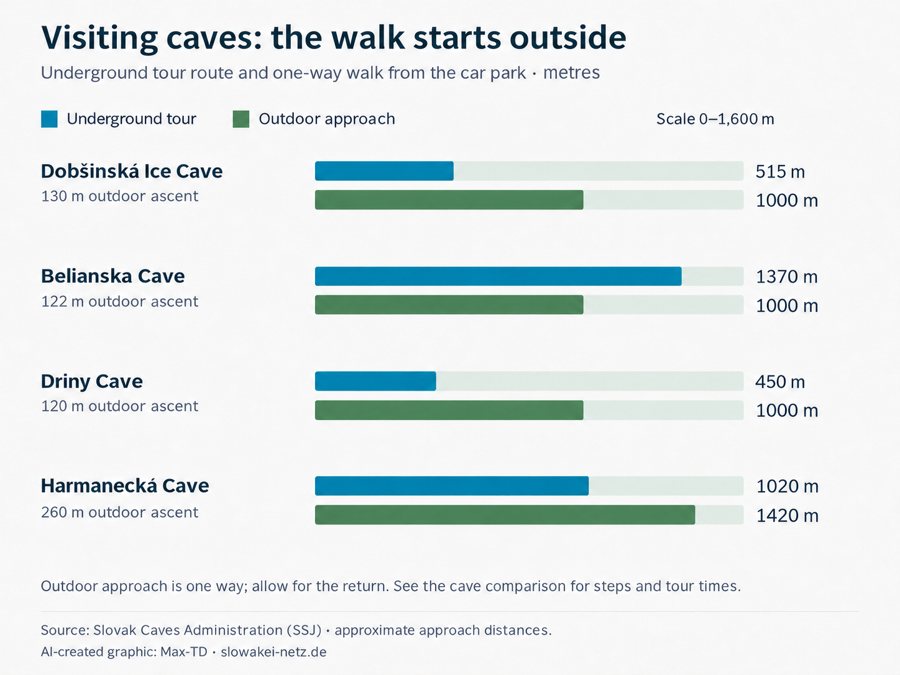
Visitor routes and outdoor approaches at four show caves. AI-generated graphic: Max-TD; information from the Slovak Cave Administration. The approach is shown as a one-way distance; add the return journey.
Share graphic
The shared links lead to this graphic and the related information on Slowakei-Netz.de.
Embed on your website
The graphic may be shared and embedded under CC BY 4.0. The code includes the image credit, Source: www.slowakei-netz.de, and a link to the licence.
Select “Copy code” and paste the code into the HTML section of your website.
